

I’d Hold High Income ETFs to Beat the SPY
Sarah Brown
The S&P 500 is wandering into uncharted territory as it looks to wander above the 6,500 mark going into the last four months of the year. It’s never been so concentrated at the top, and with valuations on the rise (it may find itself closing in on a 30 times trailing price-to-earnings (P/E) multiple), some wonder if theSPDR S&P 500(NYSEARCA:SPY) is overdue for a correction.nextstayCCSettingsOffArabicChineseEnglishFrenchGermanHindiPortugueseSpanishFont ColorwhiteFont Opacity100%Font Size100%Font FamilyArialText ShadownoneBackground ColorblackBackground Opacity50%Window ColorblackWindow Opacity0%WhiteBlackRedGreenBlueYellowMagentaCyan100%75%50%25%200%175%150%125%100%75%50%ArialGeorgiaGaramondCourier NewTahomaTimes New RomanTrebuchet MSVerdanaNoneRaisedDepressedUniformDrop ShadowWhiteBlackRedGreenBlueYellowMagentaCyan100%75%50%25%0%WhiteBlackRedGreenBlueYellowMagentaCyan100%75%50%25%0%-->-->Key PointsThe high-income ETFs could have a good run versus the SPY, as valuations stretch further into year’s end.If a mild correction or consolidation is ahead, the JEPI could be a relative winner over the SPY.Are you ahead, or behind on retirement? SmartAsset’s free tool can match you with a financial advisor in minutes to help you answer that today. Each advisor has been carefully vetted, and must act in your best interests. Don’t waste another minute; learn more here.(Sponsor)-->-->The SPY is concentrated and getting more expensive. Time for a shift to income and value?Though the top-heaviness of the index is not a bad thing (it’s been a good thing in recent years, given the outperformance of mega-cap tech and the Mag Seven names), I do think that some caution is warranted, especially as the P/E skews more towards the high side of the historical range. Of course, high P/E ratios do not necessarily suggest a crash is around the corner. Betting against the market with all this momentum could prove dangerous, especially if the AI boom really delivers next year.While I’m no fan of chasing hot markets, I do acknowledge that we’re in a different kind of environment. And, with that, a more nuanced perspective is required, given that agentic AI could certainly pave the way for faster earnings growth. Could digital labor reduce R&D spend while allowing firms to become as productive as ever? Time will tell. There’s certainly a scenario that exists where today’s high market multiples are more than deserved.Time to shift to high-income ETFs and value plays?In any case, those keen on beating the SPY (or S&P 500) may wish to skew more towards lower-cost stocks or income-focused ETFs, especially since not every bid-up AI “winner” can deliver upon expectations put ahead of them. If evenNvidia(NASDAQ:NVDA) stock can fall following remarkably strong earnings, so, too, can other high-momentum names leading this market.Could the lukewarm reception to Nvidia’s latest second-quarter results be a sign that expectations for AI names have grown high enough that the tech-led bull market may be in for more modest results moving forward? It’s tough to say. The AI boom isn’t about to slow down. However, that doesn’t mean the broad markets can’t as AI progress looks to catch up with the hype.The JEPI: An intriguing income ETFIn this piece, we’ll have a look at an income-focused ETF that I think can allow one to fare well (perhaps even better) than the SPY, especially if 2026 is the year where gains are harder to come by for AI stocks. Consider theJPMorgan Equity Premium Income ETF(NYSEARCA:JEPI), which has an 8.4% yield and 0% in returns on a year-to-date basis.Though the covered call ETF caps potential upside, I do see the ETF as winning out (at least on a relative basis) in climates that see the SPY move sideways to lower. So, if you’re concerned about the near-30 times P/E of the SPY and are fine with trading off some upside for extra income, a name like JEPI could walk away as a relative outperformer.Of course, the ideal scenario would see a volatile flat-lined market that allows for generous premiums on call options. Though JEPI isn’t immune to pain from sudden market scares (shares are still recovering from that first-half plunge), I am a fan of the security for those who think the SPY could begin to drag its feet after clocking in what now looks like three straight years of incredible performance. Personally, I think the odds of a year-long consolidation in the SPY are high. And in such a scenario, I see JEPI as an interesting name to consider.Get Ready To Retire (Sponsored)Start by taking a quick retirement quiz from SmartAsset that will match you with up to 3 financial advisors that serve your area and beyond in 5 minutes, or less.Each advisor has been vetted by SmartAsset and is held to a fiduciary standard to act in your best interests.Here’s how it works:1. Answer SmartAsset advisor match quiz2. Review your pre-screened matches at your leisure. Check out the advisors’ profiles.3. Speak with advisors at no cost to you. Have an introductory call on the phone or introduction in person and choose whom to work with in the future.

Dame Alison Rose to chair FNZ’s UK board
Sarah Johnson
ShareResizeRose will join the fund platform technology provider to 'support its commitment to making investing more accessible'Photo: Hollie Adams/Bloomberg/Getty ImagesDame Alison Rose will chair wealth management technology platform FNZ’s UK board as she continues to pick up roles after leaving NatWest.FNZ said Rose will help accelerate the firm’s strategy and “support its commitment to making investing more accessible to more people worldwide”.

I’m Lost About My Grandpa’s Social Security Money, Where Do I Start?
Sarah Davis
Of the 70 million-plus people who receive monthly Social Security checks, many rely heavily on this money. For a large percentage of this group, this money might be their only income, so it’s super important that the checks arrive on time, every month.nextstayCCSettingsOffArabicChineseEnglishFrenchGermanHindiPortugueseSpanishFont ColorwhiteFont Opacity100%Font Size100%Font FamilyArialText ShadownoneBackground ColorblackBackground Opacity50%Window ColorblackWindow Opacity0%WhiteBlackRedGreenBlueYellowMagentaCyan100%75%50%25%200%175%150%125%100%75%50%ArialGeorgiaGaramondCourier NewTahomaTimes New RomanTrebuchet MSVerdanaNoneRaisedDepressedUniformDrop ShadowWhiteBlackRedGreenBlueYellowMagentaCyan100%75%50%25%0%WhiteBlackRedGreenBlueYellowMagentaCyan100%75%50%25%0%-->-->Key PointsThis Redditor is trying to understand where his grandfather’s Social Security checks have gone.There is a good chance this is just a simple misunderstanding on the caretaker’s part and that the money went to the facility.The Redditor should still talk to both the Social Security Administration and the care center to ensure everything is handled properly.Are you ahead, or behind on retirement? SmartAsset’s free tool can match you with a financial advisor in minutes to help you answer that today. Each advisor has been carefully vetted, and must act in your best interests. Don’t waste another minute; learn more here.(Sponsor)-->-->This reliance on this money has led one Redditor posting in r/SocialSecurity to ask where the money his grandfather was supposed to be receiving has gone. After the grandfather passed, much of the Social Security money was unaccounted for, and they want to determine where it’s gone.Where Is the Grandfather’s Money?According to this Redditor, the grandfather passed away having lived in a home where he was being cared for. From the Redditor’s post, it sounds like he would receive a little bit of money that he could use as spending cash, while insurance covered the rest of his expenses, while living in this care center with 24/7 help.After the grandfather passed, the Redditor, as his next of kin, was advised by the most recent caretaker that he should explore the grandfather’s unspent checks while living at the new care center. It’s been a few months since this all happened, and after taking some time to grieve, the Redditor is considering their next steps. Understandably, the Redditor is also trying to determine if there is any outstanding money that might be owed to the next of kin, which is themselves.This Was Likely the Result of MedicareUltimately, there is likely a good indication based on what the Redditor is explaining that most of the grandfather’s Social Security was paying for his care. Instead of receiving the entirety of a check every month, for whatever balance the grandfather was entitled to, this money was going to the care center to help pay for him to live there and be cared for.While Medicare does incur some of the cost, the easy answer here is that it was Social Security that was helping out with the majority of the costs. In this case, it would also explain why the grandfather was only receiving a small amount of money each month, as that’s all Social Security will allow after the rest of the money is paid to a care center or a nursing home.As for how much the Redditor’s grandfather was receiving for spending, it depends on the state. No matter the state, there is a better-than-good chance it’s less than $100 a month after the rest of the money is given to the nursing home or care center. It’s there to help cover some of the basics, like shampoo, toothbrushes, and any essentials the grandfather might need that aren’t already provided.Still Worth Getting to the Bottom of ThisWhile there is a strong likelihood that the money going to the care center is the exact cause of checks not being received, it’s still worth exploring further. In the Redditor’s case, they should start by contacting the Social Security Administration and inquiring about any unspent benefits. If there is any money left unaccounted for that should have already been paid out, then the Redditor would have to follow the administration’s process to receive this money as a next of kin.Additionally, there is also a reason to contact the care facility and see if they will release any financial records or statements related to the grandfather’s care. This might help clear up any of the outstanding questions about where the money was being spent and how much he had to spend each month on necessities.Lastly, if the Redditor can’t get any answers from either Social Security or the care center, the last stop is a lawyer who specializes in estate planning. They will be able to guide the original poster on what needs to be done to follow the money trail. Of course, the cost of the lawyer might be far more expensive than whatever money the Redditor could stand to collect, so this is something to consider.If You have $500,000 Saved, Retirement Could Be Closer Than You Think (sponsor)Retirement can be daunting, but it doesn’t need to be. Imagine having an expert in your corner to help you with your financial goals. Someone to help you determine if you’re ahead, behind, or right on track. With SmartAsset, that’s not just a dream—it’s reality. This free tool connects you with pre-screened financial advisors who work in your best interests. It’s quick, it’s easy, so take the leap today and start planning smarter!Don’t waste another minute; get started right here and help your retirement dreams become a retirement reality.(sponsor)

The rise of Rolser: How Spain’s iconic trolley brand is rolling into international hearts
David Johnson
Well-crafted everyday objects often hide their greatness in plain sight. Consider the shopping trolley. Spanish manufacturer Rolser has spent almost 60 years developing sleek, durable designs that make life easier. These fabric-covered, two-wheeled trolleys might be associated with older people doing their weekly shop but you’ll find a Rolser trolley in the homes of 63 per cent of Spaniards, according to the family-run company. Meanwhile, on the streets of Barcelona or Madrid, you’re as likely to spot artists ferrying paint and brushes in their Rolser as you are to see families out for a day at the beach using one to stow umbrellas, chairs and snacks.Rolling in the right directionRolser’s 8 Plus model is not only made from recycled materials but is itself 100 per cent recyclableRolser was founded in 1966 as a maker of palm and wicker baskets. That it is now a fixture of life in Spain attests to its durability as a brand and the reliable quality of its products. Some 80 per cent of the company’s manufacturing takes place at its headquarters in Pedreguer, a town roughly halfway between Valencia and Alicante.Surrounded by lemon orchards and a stone’s throw from the Mediterranean, Pedreguer is the ancestral home town of the Server family. Cousins Mireia and Vicent Server are the co-CEOs of Rolser and the third generation of the family to lead the business. When Monocle visits, the pair guide us through its 21,000 sq m facility, where we see workers busily feeding aluminium tubing into a purpose-built machine, which cuts and folds the metal into the frames that give the trolleys their distinctive shape. More than 100 employees work in the factory, where some 2,500 units roll off the production line every day. Producing an average of half a million trolleys per year, the company pulled in nearly €20m of revenue in 2024.Rolser has long been the top choice of discerning Spanish matriarchs, who have a nose for high-calibre goods. But the brand now also ships to more than 60 countries and has a second factory in Vietnam, founded in 2018; there it produces textiles, such as William Morris prints, to serve equally selective consumers in Australia, China, Singapore and Japan.The heart of the business, however, remains in Pedreguer. “We have very special ties to this land,” says Vicent, over the din of workers snapping wheels onto chassis on a nearby assembly line. “By creating work for the community, we threw our support behind the people of this area and tried to foster an industry that wasn’t tourism. In itself, tourism is good – but over the years local manufacturing has largely been snuffed out.”Olivia Fornés Agulles applies the finishing touches to a PlegamaticJaime Fornés Roig is hard at work on the Rolser production lineOn the factory floor, Olivia Fornés Agulles is rhythmically working on the final assembly and packing of Rolser’s signature trolley, the Plegamatic, which folds up like a handbag and can be draped over the shoulder when empty. This year will mark 40 years since Fornés Agulles joined the company, for which her sister, brother-in-law, nephew and ex-husband also work. “At this point, it’s simply love that keeps me here,” she says with a smile. “I love this company. It has given me so much.”Mireia tells Monocle that Rolser has a deep culture of co-operation, which starts with the family. “In the end, everyone here has the same aim,” she says. “What people want most is to work in service of a shared dream and to make it a success.” To that end, key departments, such as design and sales, are headed by members of the Server clan and the company’s previous generation of leaders is helping to ensure Rolser’s longevity by advising the new guard and passing down time-tested values (Mireia’s father, Joan, is the company’s president). This approach has kept her wheels on and ensured a stable transition in leadership.Rolser was the first company in Spain to mass-produce a shopping trolley, and its strong visual branding, coupled with a refusal to manufacture items that didn’t carry the Rolser logo, has made it a household name. Supermarket chains such as Carrefour and popular department store El Corte Inglés faithfully stock Rolser merchandise.Trolley frames ready for assemblyWhile there are imitators, Vicent says that the company is maintaining its edge by making sure to invest in research and development. “Competition is great because it pushes you,” he says. “We always have two or three major projects under way that normally take about two years to fully develop.”Such innovations have included treble wheels, which make it easier to take your trolley up flights of stairs, and a version made entirely from recycled materials. Rolser also manufactures ladders and ironing boards; a recent model that’s reminiscent of a surfboard incorporated recycled clothes hangers. (About 55 per cent of the plastic materials used in Rolser products are recycled.)Mireia is determined to show the world the value of choosing a Rolser trolley over bulky carrier bags. “When I joined the company in 2000, we didn’t have a department that was dedicated to exports,” she says. “We were just selling passively to countries such as France, the Netherlands and the UK.” By 2005, the business had launched an exports division and she began attending trade fairs, such as Frankfurt’s Ambiente, where she could demonstrate the benefits of owning a high-quality shopping trolley to those outside Spain. Rolser’s regular presence at such events has spurred its team to innovate. “Every year we must present something fresh and new,” says Mireia. In 2023 the brand made headway into the US market with a chic yet sustainable model sold at New York’s Museum of Modern Art.Pattern cutting one of Rolser’s more vibrant modelsRolser recognises that an object that makes your life easier should also be pleasing to the eye. But to its design and marketing teams, true beauty lies in customers’ appreciation for their efforts and the ways in which they use the company’s thoughtfully developed wares – whether it’s for a commonplace trip to themercadoor a dash to the beach on a sweltering day.According to one faithful Rolser user, there is no cargo too precious for these trolleys. One story goes that a jeweller in Valencia was looking to transfer his precious goods to a new shop; rather than attract unwanted attention by hiring an armoured car and guards, he enlisted the help of a group of Rolser-toting grannies. Their shopping trolleys were loaded up with boxes of jewellery, with bunches of leeks placed on top – their green ends innocently poking out from the carts’ uppermost fabric flap. Jewellery in tow, the women walked through Valencia just as they would on any other day, safely delivering their cargo to its new home, with passersby unaware of the treasures held within their Rolsers. It’s a fitting anecdote: there is always more than meets the eye when it comes to an unassuming sets of wheels.Nacho MartínDesign director, Accenture SongBarrio de Las LetrasWhat’s in your Rolser?Normally food but today I’m moving some heavy design tomes with ease.Describe you Rolser in a word:Ferrari.Heather and Oliver EvansSpecialist guide (toddler still unemployed)Quinta de Los Molinos ParkWhat’s in your Rolser?Groceries, dinosaurs, cars, water bottles, peace of mind – and today, my son.How long have you had it?More than three years. I’ve had othercarritosbut once I had a child, I needed an upgrade.Javier Pérez-ViuCreative strategist and coachOutside Alma Nomad bakery, ChamberíWhat’s in your Rolser?Normally it’s sparkling water, tech cables and survival snacks. Today it’s running shoes, electrolytes and a back-up hard drive.Describe your Rolser in a word:Faithful.Daniel ChalmetaStrategic partner manager, MetaOutside Mercado Los MostensesWhat’s in your Rolser?Some eucalyptus for my flat, groceries and some new summer clothes I just bought for my birthday trip to the Baleares.How long have you had it?It came with the flat when I rented it and I use it more than I expected.Eva YatsutkoPainterWalking through MalasañaHow long have you had your Rolser?I’m a newbie. Until a year ago I was using only backpacks.What’s in your Rolser?Food. Today I’m carting vegan empanadas, four types of cheese, kiwi juice and kefir.Marisa SantamaríaResearcher, design curator and teacherPlaza de Olavide, ChamberíWhere are you going?To fully restock my fridge because I’ve been in Milan for two weeks.How long have you had your Rolser?There’s been a Rolser in my house since I can remember. They simplify the heavy slog of daily life.Jenni DawesFuture visualisation teacherWalking through LavapiésWhere are you coming from?I’m on my way back with all the materials from a workshop I run called How to Remember the Future.How do you “roll”?Mindfully.Yoeri ZavrelEyewear designerWalking through Conde DuqueWhat’s in your Rolser?Usually market-fresh groceries but today I’m carrying boxes of eyewear deliveries from my brand (Sample Eyewear, if you’re asking).How do you “roll”?Like greased lightning.Mikolaj BielskiArtistic director, Réplika TeatroBarrio de ArgüellesWhat’s in your Rolser?Imagination, surprises and uncertainty – props basically.How do you “roll”?Slightly overflowing, keeping it together, holding space for small producers.Fabián SobrinoReal-estate agentLeaving Lidl in MalasañaHow long have you had your Rolser?A few years but I wish I’d had it longer – it’s the best.What’s in your Rolser?The heaviest things, whatever fits. It’s a good alternative to plastic bags.Violeta DaiArt and project directorOutside Mercado BarcelóWhat’s in your Rolser?Today there are plants, a vase of flowers, a bunch of rocks, a bag of earth and tree bark – for a photoshoot, I promise.Describe your Rolser in a word:Señora.Read next:By opting for the trolley bag, young urbanites are proving that granny knows best

Peter Hargreaves steps down from Hargreaves Lansdown board after £5.4bn takeover
Jennifer Brown

Current price of silver as of Monday, November 24, 2025
Jennifer Davis

Manila’s Purveyr Fair puts Filipino brands on the path to rapid growth
Sarah Davis

Citi’s James Holder: ‘We should all wave the flag for London a little bit more’
Emily Smith

Laurent Kleitman on the future of luxury hospitality, Mandarin Oriental’s growth and ‘The White Lotus’ effect
Emily Miller

Amber River board meets to decide between final bidders for UK wealth manager
David Jones
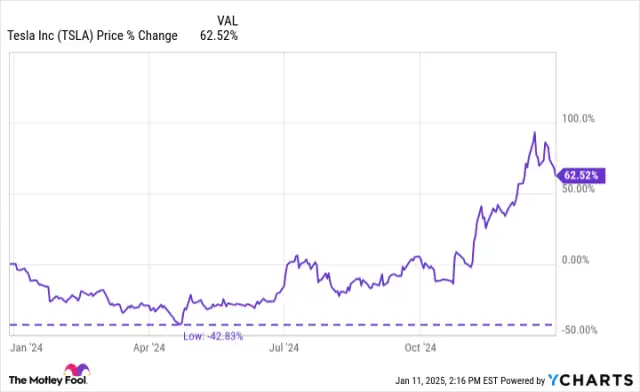
Is it a good time to invest in Tesla stock before January 20?
Robert Miller
January 20 is turning into a significant day for Tesla shareholders. Tesla (TSLA 8.04%) is one of the most volatile megacap tech stocks. While owning Tesla has been (mostly) a great decision over the long term, timing has often been critical. The company is working on several thrilling initiatives related to its electric vehicles and artificial intelligence (AI), yet I'm taking a cautious approach as an investor for now. In the following sections, I'll explain why January 20 might be a significant date for Tesla shareholders and discuss whether it would be wise to invest in the stock prior to that date. Analyzing the fluctuations in Tesla's stock price Let's break down Tesla's stock performance in 2024. View pictures in App save up to 80% data. Information sourced from YCharts. Between Jan. 1 and Nov. 4, 2024, Tesla stock was down 2.3% and trailing the S&P 500 by a wide margin. However, shares were actually down as much as 42.8% at one point during this period. Following Donald Trump's victory in the U.S. presidential election on Nov. 5, Tesla stock found new life. Between Nov. 4 and Dec. 31, shares gained 66.3%, and the company reclaimed its position in the trillion-dollar club. Tesla CEO Elon Musk emerged as a major Trump supporter during the final months on the campaign trail. Investors began to see the Trump-Musk alliance as a bullish indicator for Tesla. Although this might seem beneficial for Musk and the company, if you take a look at the stock's performance towards the end of the year, you'll notice that Tesla started to decline. As of now, shares have dropped 14.3% since Christmas Eve. At the end of the year, it's quite typical for investors to sell stocks, particularly those from companies that have seen significant profits in a brief timeframe. Additionally, Tesla has recently released its delivery and production numbers for its electric vehicle division for the fourth quarter, revealing that they fell short of Wall Street's forecasts. While Tesla's stock seems to be on a downward trajectory, I wouldn't be shocked if we witness a recovery in share prices as January 20 approaches. Let's explore the reasons behind this potential rebound. What events are taking place on January 20? On Jan. 20, President-elect Donald Trump will be sworn into office. Given Musk's ties to the soon-to-be president, I would not be shocked in the slightest if Tesla stock starts to see an uptick. Here's the reality: While Musk's relationship with Trump may bode well for Tesla -- especially as it relates to a friendlier regulatory environment for the company's autonomous driving ambitions -- any gains leading up to or immediately following the inauguration are driven by a narrative, not Tesla's fundamentals. View pictures in App save up to 80% data. Photo Credit: Getty Images Is it a good idea to buy Tesla stock before that date? Since the election, Tesla has fared much like a meme stock. Nothing about the company changed on Nov. 5. Nothing is going to change for it on Jan. 20, either. Investors don't know how the company's autonomous driving efforts will shake out or what regulatory changes the incoming administration will make in that area. If you're considering investing in Tesla stock at this moment, it's essential to have faith in the company's future plans regarding AI, autonomous vehicles, and robotics. If you do, the timing of your share purchase becomes significantly less important. Otherwise, investing in momentum stocks like Tesla is usually risky. If you have a low tolerance for risk, you may want to steer clear.

In defence of middle management: why bureaucracy keeps companies running
Jane Williams
“The ideal racing car would be one that beat its nearest rival by a couple of metres and then immediately fell to pieces.” This apocryphal statement is most convincingly attributed to Colin Chapman of Lotus but it might also have been Ferdinand Porsche who said it. Regardless of its true origin, the quip captures a certain kind of design philosophy. When there is a specific task to be achieved, the most elegant solution is the one that precisely achieves that objective with minimum resources. Anything extra – a slightly bigger winning margin, a little more robustness – is a waste.But it’s a bit of a conjuring trick. This approach only makes any sense at all because winning a race is a very specific and unusual objective for an automobile: driving a known distance, over known terrain, with a defined victory condition. If you wanted to apply this philosophy to any other kind of car, how would you even begin to do so? Is the ideal SUV one that finishes the school run at exactly 08.59 and then explodes? Of course not.A strange thing has happened in our political and economic system, however. Without really realising, many organisations and companies have decided to adopt this proverb as a philosophy of management. In the name of efficiency, governments and businesses have spent the past few decades trying to remove management, cut bureaucracy and eliminate waste.The results are disappointing and occasionally disastrous. Trying to slim down the government has resulted in higher ratios of tax to GDP and lower economic growth. Companies that have managed themselves to maximise financial returns have ended up stripping out innovation and stumbling from one crisis to the next. Nearly all of the actual value that has been created this century has been in companies that concentrated on technology and customer service, not on shareholder returns.A large proportion of the modern world’s problems comes down to something as simple as this: the pursuit of a mistaken set of design principles and an excessive concern with efficiency in a world of uncertainty. As computer scientist Donald Knuth once put it, “Premature optimisation is the root of all evil.” This means that the measures making a system more efficient in one environment can be disastrous in another. Because of this, you absolutely must not try to optimise something until you’re sure of the problem for which you are optimising.So what might be a better design philosophy? How can we design systems that won’t fall to pieces as soon as they cross a hypothetical finish line? Weirdly, the answer might be that we need to take another look at one of the most maligned classes of knowledge workers: the middle manager.What do middle managers actually do? A lot of the time, they seem to get in everyone’s way. They hold interminable meetings, compile handbooks and policies, and spend every spare moment engaged in internal politics. If we define a “middle manager” as somebody who is not directly involved in producing the product or talking to the customer, it’s not hard to see why they have always attracted suspicion. If there is any waste or dead wood in an organisation, middle management is often where it’s found.But let’s look again at those activities and ask a question that used to be taken much more seriously: what is an organisation for? Why do companies employ a permanent staff at all, rather than just buying services and hiring staff by the day on an open market? If we go beyond the assumptions of conventional economics, in which information is assumed to be frictionless and perfect, and think about the actual mechanisms by which it is preserved and transmitted, we get some real answers.The application of the theory of information to organisations used to be called “management cybernetics”, a school of management theory so totally eclipsed by “shareholder value” that it scarcely exists today beyond second-hand bookshops and the personal idiosyncrasies of some ageing professors.A company produces products but its management produces decisions. A company, or any other organisation, is an information-processing system – in effect, an artificial intelligence consisting of people, memos, telephone calls and emails. The reason that a large permanent organisation exists, rather than a “virtual” company made up of outsourced services purchased by a single founder, is that the information-processing system needs more bandwidth and more storage than any single human can provide. Humans form organisations to extend their capacity and take on bigger projects than they can achieve on their own. That’s as true of decision-making as it is of bridge building and iron smelting. The Industrial Revolution was a revolution in the industrialisation of decision-making, not just of manufacturing.That’s what good middle managers do. They hold knowledge and make communication happen so that the organisation can work. The real job of middle management is to ensure that information arrives where it needs to be, in a form in which it can be the basis for a decision and in time to be useful. To do this, middle managers use a lot of standard techniques. They write down policy manuals so that commonly recurring decisions can be sped up or delegated to front-line staff. They send memos and emails to get the facts to the right places. And, yes, a lot of the time, they hold meetings, partly to keep looking for information and to share it but also to build the formal and informal communication channels that will come in handy at some future date.The failure to employ enough of these people (or, worse, to employ them but not listen) leads to a kind of corporate cognitive disorder that’s sometimes called “founder’s syndrome” when it happens in start-up companies. (When it happens in larger or established corporations, it’s just called “being badly managed”.) Founder’s syndrome is what happens when a company’s first management team is unable to understand, or to accept psychologically, that the organisation is now bigger than its capacity to process information. The symptoms of founder’s syndrome can be obvious (except to the person who’s causing it). Details get missed, deadlines are stretched, processes can’t be scaled up and everyone starts talking about “micromanagement”. But, even more destructively, the organisation develops tunnel vision. Only information that can get through the founder’s screens can affect anything, just at the moment in time when the founder is least likely to have the spare bandwidth to think about the outside world. Venture capitalists are often highly attuned to the risk of founder’s syndrome and start to demand that visionaries stick to having visions, then “hire good people and let them get on with it”.So who’s right? To answer anything other than “it depends” would show a profound lack of respect for the question. To solve a problem in any specific case, we need to go back to the design principles and take seriously the idea that an organisation is an information- processing system. Taking this approach is like putting on a pair of magic glasses that suddenly reveal the true structure of management reality. Is this role helping the flow of information or hindering it? Does having this policy help to free up time for creative thinking or does it consume time in dealing with exceptions and details of the policy? Is the organisation focused on immediate here-and-now problems or is it able to look outside and to the future – and can it effectively deal with outside information once it has been gathered? And, perhaps most crucially, how would things look if the world changed?What is interesting here is that none of these questions seems to be closely related to cost efficiency or shareholder value. There is a pretty good reason for that: you can’t understand a business by looking at its accounts. An accounting system is one way of organising some kinds of information about certain aspects of a company. And it’s always backwards-looking. This makes it into exactly the kind of information-reducing filter that can dangerously impair your ability to adapt.You might put it like this: almost always, the amount of money that a project will cost is vastly less important than the simple question of whether it’s likely to work or not. But all too often, people spend all of their effort on the former rather than the latter. We don’t even have a word equivalent to “costing” to describe a process of thoroughly and rigorously estimating the benefits of doing something. And so we get the kind of companies and projects that we deserve because we treat financial returns as the only goal of business, rather than one constraint among many that has to be met on the way to doing something truly interesting.In our current economy, founders are often the only people who have the social and institutional permission to look beyond the accounts, take risks and think about the big picture. But it doesn’t have to be that way. Consider Nokia, for example. A century ago, the company made rubber boots; today, it makes telecom switching equipment. Content and entertainment group Vivendi used to run the sewerage system in the town of Lyon. Less dramatically, IBM and Apple have reinvented themselves several times.The good thing about “founder mode” might be that a company with a strong sense of identity and purpose has the ability to adapt to its environment. It isn’t a supercar that delivers outstanding performance in a straight line, then wrecks itself on the first speed bump.Perhaps the last lesson of cybernetics is exactly that a sense of identity and purpose is at the heart of what makes an organisation work. You can only start thinking about a company from an information-centred perspective once you have first decided what counts as information, what the system “cares about”. This is the true responsibility of founders in a start-up. In an established corporation, it might rest with the CEO but it’s more likely to be distributed across the whole of the management.The distinction between founders and managers, modes and syndromes, is a false one. Excess bureaucracy is not always bad, nor is efficiency always good. What matters for a company is viability – the ability to respond to unanticipated changes. And the cornerstone of viability is self-knowledge, the understanding of what the company is for.That is the start of being able to describe what kind of environment it needs to be able to cope with – and only then does it make any sense to start optimising. Middle managers are the brain of the firm but the brain needs to follow the heart.About the writer:Dan Davies is a journalist, author and former Bank of England economist who has worked as an analyst for several investment banks. His books includeLying for MoneyandThe Unaccountability Machine.Read next:How we work must change – let’s not have a meeting about it

Preppi’s Emergency Radio aims to ensure that its user looks good in any apocalyptic scenario
David Davis
There aren’t many products that you purchase in the hope that you’ll never have to use them. But as fears of disaster, either natural or manmade, once again enter the public consciousness, a growing number of companies are pitching products at “preppers” – people preparing for the worst. One of these is Preppi, a Los Angeles-based company whose handsomely designed apocalyptic products include medical kits, survival backpacks and emergency radios. The radio features a USB charger powered by a large solar panel (a wind-up arm can supply power if it dies in the dark), plus an SOS siren, LED torch and weather-band frequency functionality to receive updates if there is no internet connection.“The fires in LA at the start of this year really opened some eyes,” Lauren Tafuri, who co-founded Preppi with Ryan Kuhlman, tells Monocle. “Lots of people realised that they were unprepared in a scenario like that.” The company has support in high places for their mission. In March the European Commission made an advisory statement that all of the bloc’s citizens should assemble a 72-hour emergency kit as part of its crisis-preparedness strategy. “Our backpacks matched the specifications perfectly,” says Tafuri.Those preparing for disaster were once considered cranks but the wider availability and effectiveness of survivalist equipment, combined with a fashion for technological clothing, has encouraged a more discerning consumer. “Our products are built to be used. If required in a crisis, they must be functional as a priority,” says Kuhlman. “But why should that mean that they have to look like they’ve come straight from military surplus?”preppi.coCommentTechnology that once would have been considered too niche for general consumers is now readily available for purchase. So why not make it look good?Want more stories like these in your inbox?Sign up to Monocle’s email newsletters to stay on top of news and opinion, plus the latest from the magazine, radio, film and shop.Your EmailSubscribe

How bosses at UBS, Citi, HSBC are embracing AI
Sarah Williams
ShareResizeSenior leaders, such as UBS’s chief executive Sergio Ermotti, have become AI ‘role models’ to show their workforce that there’s no need to fear the new world orderPhoto: NurPhoto via Getty ImagesThis is an online version of Financial News’s wealth management newsletter. To subscribe click hereWealth managers have learned to stop worrying and love AI. They had been slower than other finance peers to embrace the copious number of AI tools on the market, but have now come torealise AI’s game changing potential.

Japan’s tiny electric vehicle with very big ambitions
Emily Davis

Should I Trade In My $67,000 Jeep Wrangler for a $15,000 Infiniti and Eliminate Payments?
Jane Johnson

Three Mexican companies bridging the country’s offline workforce with global clients
David Davis

Current ARM mortgage rates report for Nov. 26, 2025
Emily Johnson

Amid flying taxis and sustainability deals, the Dubai Airshow tests the industry’s lofty promises
Sarah Miller

Poltrona Frau is the quiet €120m powerhouse behind luxury car interiors
Sarah Davis

Why wealth manager shares have skyrocketed
John Brown

Former Newton IM chief Euan Munro joins Brooks Macdonald board
Emily Miller

Current refi mortgage rates report for Dec. 1, 2025
John Smith

I Make $40,000 a Year – What Should I Do With My $800,000 Inherited Roth IRA?
John Williams

SJP plots fund manager hires as Polaris range hits £80bn
Jennifer Johnson

Should I buy a $75,000 Tundra with my $100,000 salary and $60,000 in savings?
Sarah Miller
Latest Articles
Seafuture is the trade show racing to shape the blue economy with underwater power
Jane Jones
Goldman Sachs promotes 15 in Emea wealth team to MD
Sarah Davis
Axos Bank review 2025: High APY options for checking and savings but subpar CD rates
Robert Williams
Deutsche Bank wants more UK private bankers
Michael Smith
The year in FN Wealth Management
Sarah Miller
Bain still in hunt for UK wealth firm Amber River as bidding continues
David Smith
I Struggled to Repair My 2010 Prius And Don’t Know If It Was Worth the $4,300 Investment
Michael Davis
I Regret Financing My New Car – What Are My Options for Managing Payments?
Jennifer Williams
Dave Ramsey Said to Claim Social Security at 62- Here’s Why You Shouldn’t Follow His Advice
John Jones
True Potential’s wealth business swings to a £243m loss after FCA review
Robert Williams